

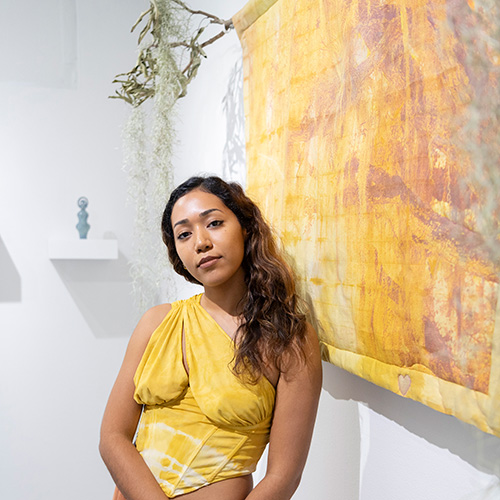
Diana Eusebio - The Royal Palm South Beach Miami
Home, Safe (2025-2026) and Ceiba (2025) explore how natural dyes can map migration by tracing the movement of plants, people and knowledge across the Americas. Born and raised in Miami as the daughter of Peruvian and Dominican immigrants, Diana Eusebio uses textiles, photography and natural dyes to reflect on belonging and the migrant search for safety.
Building on Home, Safe (2025-2026), originally exhibited as part of her 2025-2026 solo museum exhibition at MOCA North Miami, the title references the baseball term used when a player safely arrives at home plate. Baseball acts as a major economic and cultural catalyst for migration from the Dominican Republic to the United States. Eusebio compares the baseball player's plight around the bases in search of home and safety to the immigrant's search for belonging. Eusebio a child of immigrants herself feels the safest and most at home in nature, rather than in a geographical place. Therefore, the artwork embraces visitors through the tranquil experience of standing beneath the canopy of a tree, looking toward the sky, and taking a moment to safely breathe. The reimagined installation at the Royal Palm draws inspiration from hotels as spaces of transition, where people make themselves at home, inviting guests to experience a moment of tranquility within the rhythm of the hotel. Naturally dyed with indigo leaves originating in Latin America and harvested in the U.S., the work's materials connect plant histories to migration across the Americas, inviting viewers to feel sheltered by the tree's presence, safe and at home.
One of Miami’s most historic trees is envisioned for the Royal Palm’s historic lobby. Planted in 1915, this Ceiba pentandra, known as the Ceiba or Kapok tree, still lives in the Key Biscayne Village Green. Native to the Caribbean, Central and South America and Africa, it was carried here across oceans, much like the people who would later make Miami their home. Ceiba stands as both immigrant and witness. When Eusebio photographed the tree, she was struck by its immense stature. Kapoks can reach up to 230 feet tall. Its towering presence has endured and grown alongside the city, silently archiving history. In indigenous Caribbean and Latin American cosmologies and Mayan and Taino practices, the Ceiba is the Tree of Life, the axis connecting the underworld, earth and sky, holding memory in its branches. Today, in a climate of fear and propaganda against immigrants, Ceiba (2025) and Home, Safe (2025-2026) tell another story: one of belonging through movement, resilience and landscapes enriched by crossed borders.
Diana Eusebio (b. 1998, Miami) is a Peruvian-Dominican textile artist from Miami. Eusebio holds a BFA in Fiber from MICA. During Art Basel 2025-26, she opened a solo museum exhibition at MOCA, North Miami. Publications include Art Newspaper, Financial Times, Impulse, Whitewall, Artforum, Hyperallergic, WLRN, Surface Design, Vogue, Paper, The New York Times and Cultured. Select presentations: MoMA (NY), SVA (NY), Sotheby’s (NY), Rutgers (NJ), Hall of Nations (DC), PAMM (FL), Rubell Museum (FL), Ringling Museum (FL), Gregg Museum (NC), University of Massachusetts (MA), Nouveaux Deuxdeux (Germany), Palazzo de Cartelloni (Italy), Pinta (Peru) and Museo de Arte Moderno (Colombia). Select awards: 2016 U.S. Presidential Scholar in the Arts, the highest national honor for young artists, 2024 YoungArts Jorge M. Perez $25,000 Prize. Select residencies: Textile Arts Center, Brooklyn; Catskills Art Space, NY; Anderson Ranch, Aspen; Bakehouse Art Complex, Miami.


